
Projet ABCD
Acceptable close-Body Co-working Drone
Pitch
Recent progress in aerial robotics foresees that flying robots, a.k.a. drones, can support workers in their jobs, such as by performing complex tasks in hard-to-reach places. As drones become increasingly autonomous, we envision them helping workers in direct collaborative tasks, such as by carrying tools and handing them over to workers at heights, or helping them lift and precisely position structures on construction sites. Yet, much research is needed to support safe close-body interaction between humans and drones. In this project, we proposed to investigate strategies for co-working drones approaching a human user in view of interacting with them at close proximity. In particular, we proposed to investigate how to approach the user and reach a drone’s final position by the user.
Objectifs
- The objective of the mobility was the identification of factors affecting safe and acceptable drone placement and movement as a first step towards close-body interaction for co-working purposes.
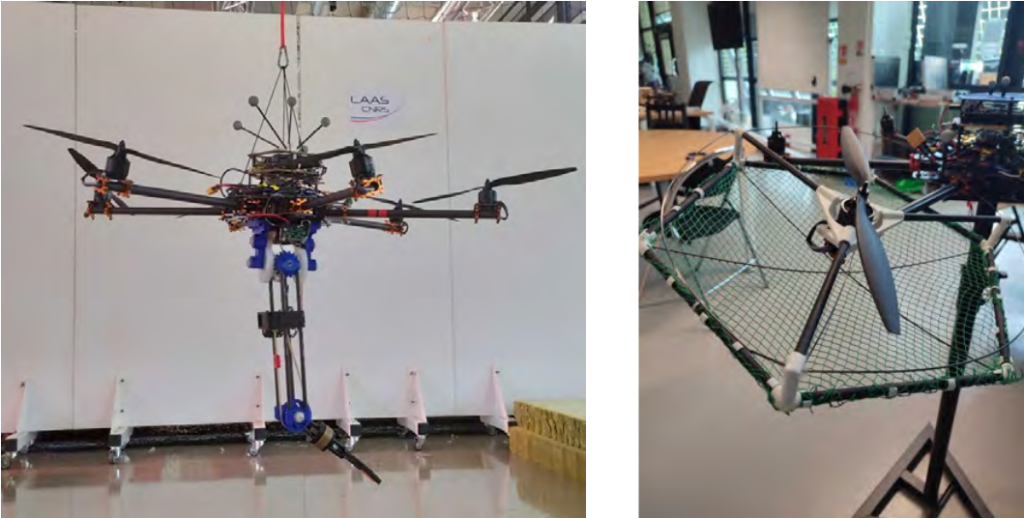
drone’s propellers fitted with a guard as used in the study
Type de financement
Mobilité entrante
Chercheur
Jessica CAUCHARD
Chercheurs accueillants
Anke BROCK
Daniel SIDOBRE
Marco COGNETTI
Partenaires
Ben Gurion University
ENAC
Mots-clés
Drone
Positioning
Co-manipuling / Exchanging tools
Collaborative task
Human-drone interaction
Date
1/02/2023 au 31/07/2023
Tutelle
LAAS-CNRS