[1] van der Scheer, J.W., Goosey-Tolfrey, V.L., Valentino, S.E. et al. Functional electrical stimulation cycling exercise after spinal cord injury: a systematic review of health and fitness-related outcomes. J NeuroEngineering Rehabil 18, 99 (2021).
[2] Ibitoye MO, Hamzaid NA, Hasnan N, Abdul Wahab AK, Davis GM (2016) Strategies for Rapid Muscle Fatigue Reduction during FES Exercise in Individuals with Spinal Cord Injury: A Systematic Review. PLoS ONE 11(2): e0149024.
[3] Schmoll, M., Le Guillou, R., Lobato Borges, D., Azevedo-Coste, C et al. Standardizing fatigue-resistance testing during electrical stimulation of paralysed human quadriceps muscles, a practical approach. J NeuroEngineering Rehabil, 2021.
[4] D. Popović, R.B. Stein, N. Oğuztöreli, M. Lebiedowska, and S. Jonić, “Optimal control of walking with functional electrical stimulation: a computer simulation study,” IEEE transactions on rehabilitation engineering, 1999.
[5] Wolf DN, van den Bogert AJ, Schearer EM. Data-Driven Dynamic Motion Planning for Practical FES-Controlled Reaching Motions in Spinal Cord Injury. IEEE Trans Neural Syst Rehabil Eng. 2023;31:2246-2256.
[6] N. Kirsch, N. Alibeji and N. Sharma, « Nonlinear model predictive control of functional electrical stimulation, » in Control Engineering Practice, vol. 58, pp. 319-331, 2017, doi:10.1016/j.conengprac.2016.03.005
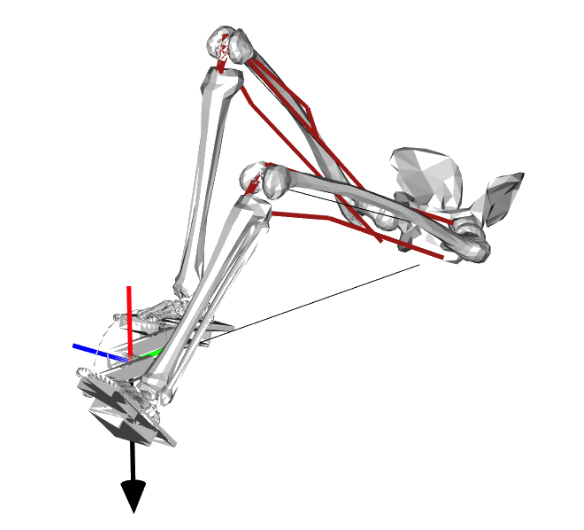
[7] Coelho-Magalhães, T.; Azevedo-Coste, C.; Bailly, F.. FES-induced musculoskeletal trajectory optimization with an adapted muscle model. IFESS 2024, Sep 2024, Bath (UK), United Kingdom. ⟨hal-04701752⟩
[8] Coelho-Magalhães, T.; Azevedo-Coste, C.; Bailly, F.. Numerical Optimal Control Compliant Physiology-Based Muscle Model for Electrically Stimulated Induced Contractions. Currently under review in IEEE Transactions on Medical Robotics and Bionics (T-MRB). It is going to be shared under a confidential statement.
[9] B. Michaud, F. Bailly, E. Charbonneau, A. Ceglia, L. Sanchez, and M. Begon, “Bioptim, a Python framework for musculoskeletal optimal control in biomechanics,” IEEE Transactions on Systems, Man, and Cybernetics: Systems, 2022.
[10] F. Bailly, A. Ceglia, B. Michaud, D. M. Rouleau, and M. Begon, “Real-time and dynamically consistent estimation of muscle forces using a moving horizon EMG-marker tracking algorithm—application to upper limb biomechanics,” Frontiers in bioengineering and biotechnology, vol. 9, no. 642742, Fev. 2021.
[11] A. Ceglia, F. Bailly and M. Begon, “Moving horizon estimation of human kinematics and muscle forces,” IEEE Robotics and Automation Letters, vol. 8, no. 8, pp. 5212-5219, 2023.
[12] Coelho-Magalhães, T.; Fachin-Martins, E.; Silva, A.; Azevedo Coste, C.; Resende-Martins, H. Development of a High-Power Capacity Open Source Electrical Stimulation System to Enhance Research into FES-Assisted Devices: Validation of FES Cycling. Sensors 2022, 22, 531.
[13] Coelho-Magalhães, T.; Azevedo Coste, C.; Resende-Martins,H. A Novel Functional ElectricalStimulation-Induced CyclingController Using ReinforcementLearning to Optimize Online MuscleActivation Pattern. Sensors 2022, 22,9126.
[14] Le Guillou, R.; Schmoll, M.; Sijobert, B.; Lobato Borges, D.; Fachin-Martins, E.; Resende, H.; Pissard-Gibollet, R.; Fattal, C.; Azevedo Coste, C. A Novel Framework for Quantifying Accuracy and Precision of Event Detection Algorithms in FES-Cycling. Sensors 2021, 21.
[15] T. Bakir, B. Bonnard, S. Gayrard, and J. Rouot, “Finite dimensional approximation to muscular response in force-fatigue dynamics using functional electrical stimulation,” Automatica, vol. 144, no. 110464, Oct. 2022.
[16] M. S. Marion, A. S. Wexler, and M. L. Hull, “Predicting non-isometric fatigue induced by electrical stimulation pulse trains as a function of pulse duration,” Journal of NeuroEngineering and Rehabilitation, vol. 10, no. 13, Feb. 2013.